Showing posts with label Stories. Show all posts

Sunday, March 16, 2014

What Patok Jeeps and Awful Radio Remixes taught me about life

Back in college, I used to commute from home to school and back. I regularly ride the 'patok jeeps' because they are accessible, cheap and fast. Patok jeeps are just like your typical jeepneys in the country-- with some modifications. If you see jeepneys with decorations all over their chassis, from inutile decorative antennas, to abstract paintings, to mottos devoid of meanings, to various attachments of statues of horses, eagles, what have you, Patok jeepneys are steroid-enhanced versions of those jeeps. They come with more decorations, more colorful paintings, disco lights to boot and its signature large loudspeakers playing disco-remixed music from the 80's and 90's.

Patokstep, the Pinoy version of dubstep, as I'd like to think of it. Take 'Sometimes When We Touch' by Dan Hill. Then add a generic bass drum heavy beat and some DJ muttering senseless words randomly  like the one below:


And you get the Patokstep.

I  found some remixes in youtube with this type of sound:


It doesn't sound so bad actually. I knid of like it. It's the music they play during fiesta disco nights in the provinces. (Maybe that's why I like it, because of the nostalgia factor. Aw.)

There's another type of songs they play in these jeepneys. The Christmas remixes. They take a very famous novelty song from that year, give it a Patokstep remix then make it a medley with another Christmas song with Patokstep mix. Then add 1 or 2 more songs in the mix. You get the Mandatory Generic Christmas
remix of the year. Like the one below.


Anyway, during my first rides on these jeepneys, listening to these music is unbearable, what with the very loud sound and the repetitive tunes. But days passed and I began to get comfortable with the songs. In the end I just learned to go with the rhythm (I don't really dance or jive to the music but I just learned to be at peace with it, the repetitions serving as a melodic meditation chants for me.)

So in the end, I realized that I did not notice the long journey, the traffic, the heat and smoke, as long as I tune in and meditate with the music.

What I'm saying is, life is full of noise. It's up to you if you want to hear them still as noise or transform them into wonderful music. I'm reminded of the movie 'Another Earth', where the main character tells an anecdote about an astronaut in space who keeps hearing a ticking sound but he can't find the source. It keeps on ticking when he is awake. Tick tick tick.  And even when he sleeps. Tick tick tick. He seems to be losing his mind because of the sound. But then later he found that he can make this ticking sound serve as a background percussion of any song he imagines in his head. Sort of a Heavy Bass drum mix. Then he became at peace with sound because he can just hear nice music.

Back in college, in another jeepney ride, there was a father and his daughter. The daughter seemed agitated by all the travels and seems to be on the verge of crying. The father consoles him by saying 'Enjoyin mo lang anak' (Just enjoy [the ride] my child'. I find his advice very simple yet true.

It's a matter of enjoying what you have and looking at the positive side of your problems.


Wednesday, April 18, 2012

Living City - The Case for Urban Motility


The ability to move is a characteristic of most living things. Single-celled organisms could move using their whip-like appendages. Terrestrial animals move by walking or crawling. Other organisms move by flying, swimming, or burrowing. Movement allows these creatures to gather food more efficiently, to find shelter timely, or escape predators quickly. Thus, one could conlude that movement is necessary for the propagation of species and of life.

In a dynamic world, the ability to move and relocate is a very beneficial skill. This is not irrelevant to cities where multitudes of buildings, vehicles and citizens dwell. In the future where we face a vastly increasing scarcity of resources but ever expanding land area (see Dubai development) a walking and adapting city would prove to be crucial. Hence we ask, for a living city, how do we make it mobile?

Lego Crawler City

Mobile Cities in fiction...

In a city as big as Manila for example, frequent large-scale relocation is a very difficult if not impossible undertaking. Many science fiction stories have proposed elaborate means of moving a city. One search in Wikipedia will give the following results for moving cities from books and video games (1):

The four novels in Philip Reeve's Mortal Engines Quartet (Hungry City Chronicles) include large mobile Traction Cities that travel across the world, devouring each other to gain fuel and other resources. 
A massive city travelling along equatorial rails around the planet Mercury is the setting for a minor part of Blue Mars, the last book in the Mars Trilogy of Kim Stanley Robinson. The city is pushed along by the slight yet powerful expansion of the rails as the close-by sun shines on them (with the city always just staying within the planetary night), moving the city once around the planet every 88 Earth days. The same city appears in Robinson's early novel The Memory of Whiteness.
There is a similar arrangement in Timothy Zahn's Heir to the Empire, where Nomad City avoids Athega's light by continually moving over the surface of Nkllon. 
In Alastair Reynolds's Absolution Gap, vast cities circle the moon of Hela to keep the planet Haldora in view, in case "the Miracle" – the momentary disappearance of Haldora – occurs again. The mobile cities are called Cathedrals and are devoted to worship of the Miracle, which they believe is God's message to humanity. 
In Christopher Priest's novel Inverted World a city on a "hyberbolic" planet is continually moved on rails to keep it at a particular location—which itself moves—where conditions are "normal". 
Greg Bear's novel The Strength of Stones is set in the declining years of a planet of motorized cities that ejected their inhabitants. 
Storm Constantine's novel Calenture takes place in a world of mobile cities that fly, walk or move on wheels, guided and powered by "pilot stones". 
The computer game Starcraft features an interstellar empire of humans that use collections of mobile buildings to assemble ad-hoc cities in space and on land.

...and in real life.

In the same Wikipedia page, we will find that there has been proposals for moving cities in real life.
The Walking City was an idea proposed by British architect Ron Herron in 1964. In an article in avant-garde architecture journal Archigram, Ron Herron proposed building massive mobile robotic structures, with their own intelligence, that could freely roam the world, moving to wherever their resources or manufacturing abilities were needed. Various walking cities could interconnect with each other to form larger 'walking metropolises' when needed, and then disperse when their concentrated power was no longer necessary. Individual buildings or structures could also be mobile, moving wherever their owner wanted or needs dictated.


Following a link in the same page, we learn of the moving fort Gulyay-gorod used in Russia (2).
Gulyay-gorod, also guliai-gorod, gulay-gorod, literally: "wandering town"), was a mobile fortification used by the Russian army between the 15th and the 17th centuries.
A gulyay-gorod was made from large wall-sized prefabricated shields with holes for guns installed on wheels or sleds, a development of the wagon fort concept. The usage of installable shields instead of permanently armoured wagons was cheaper and allowed more possible configurations to be assembled. The gulyay-gorod was designed as a fortification in steppes, whose flat, void landscape provided no natural shelter. An early Western description of the gulyay-gorod was made by Giles Fletcher, the Elder, ambassador to Russia, in his Of the Russe Common Wealth.

One can consider other real life examples like a town that follows a railroad. One could also argue that aircraft carriers or large cruise liners is some form of a floating city. The main argument against these though is that there is no form of autonomous government and social institutions that comprise these moving "cities". There may be captains on a ship but a real city needs to have a city hall, school, hospitals, cemeteries, prisons etc.


Urban Mobility - true form

A common characteristic from the above moving cities is the vehicle for transport. The city does not really move by itself, it is just built above a moving transport vehicle such as a ship, or a railroad etc. 

It may seem too science fictional to mention but real motility would mean that the city should be able to move-- its buildings, its roads, its lands.

I found this advertisement for Volkswagen Tiguan created by the DDB Milano, Italy Advertising Agency where a city dynamically moves its pavements and buildings to accomodate the citizens (3). One could see the roads realigning to adapt to pedestrians crossing. The buildings opening up a road for the car to pass through.


This may be impossible to achieve at present since it would require a large amount of moving gears, belts, chains and such. It woud also require a very smart central processing unit to calculate the changes needed to accomodate and adapt to the citizens' activities.

But such concept can be simplified to support just the movement the city from one place to another-- relocation. This feat can be done using the idea of urban sprawl and blight.


Sprawl versus Blight

Sprawl is defined as the "the spreading out of a city and its suburbs over more and more rural land at the periphery of an urban area. This involves the conversion of open space (rural land) into built-up, developed land over time" (4).  Comparing this with a living cell, (of a tree for example) a sprawl is that part of the tree where new cells are created as the tree grows i.e. the budding parts.

In some urban studies,  sprawl is sometimes construed to have negative effects on a city as it has many negative effects on the environment or on the vitality of the city itself.

Blight on the other hand refers to the deterioration and decay of buildings and older areas of large cities, due to neglect, crime, or lack of economic support. If sprawl signifies growth, blight signifies decay and rot.


What about it?

Imagine a typical city. Let's make this city very consistent and homogenous. Let's put a constant sprawl rate on its north border. By itself we would have an ever expanding city to its northern lands , expanding to some extent until the city is not able to support itself anymore and it just disintegrates.

Now make it so that blight will be on the southern edge with rate of decay that match the rate of sprawl. We would then have a city that maintains it's status quo because of the opposing forces of blight and sprawl. Which in effect would move the city into the direction of the sprawl leaving a trail of derelict buildings on its path of blight.

We thus have created a moving city devouring everything in its predatory sprawl and excreting rotten buildings in its blight. We can then structure this city based on this fact. Build the residences, entermainment centers, leisure parks in the sprawl area. Put the government buildings at the center. Put the cemeteries, prisons, garbage dumps on the blight zone. Decaying objects are left behind, while new ones are created up front.

The mayor acts as the pilot; determines the direction of movement. All hands on deck. Full speed ahead!


Links:
(1) http://en.wikipedia.org/wiki/Walking_city
(2) http://en.wikipedia.org/wiki/Gulyay-gorod
(3) http://www.youtube.com/watch?v=6TBiHkPFBTw
(4) https://www.numbersusa.com/content/learn/issues/environment/what-sprawl.html-0

Images:
http://motherboard.vice.com/2010/2/23/crawler-town-the-mobile-city-of-the-future-in-legos--2
http://www.seriouswheels.com/ghi/Hoop-Matchbox-Hero-City-Mobile-RA.htm

Wednesday, November 16, 2011

Hopes and Dreams and the Parallel Universe

There are lots of symbolisms and metaphors in Scifi and Fantasy stories.

Werewolf stories are seen as metaphors for adolescence and coming of age. Vampire stories are sometimes seen as representation for intimacy amidst rejections and differences. Robots and AI tales are symbols of anti-slavery and uprising against an established authority.

Stories about Parallel Universes, on the other hand, are about hopes and dreams. A parallel universe is a place where we are a different person, a place where your dreams may have come true (or not). A place were we hope good things happened to our lives.

On the same light, time travel stories are about wistful thinking; what if I did this or that etc.


:end babble:

Tuesday, October 25, 2011

2 Worlds in Fiction

Most stories revolve in a battle between two entities, good versus evil, black vs. white, strong vs. weak and so on. My favorite stories are those that discusses this rivalry but adds a very different twist to it.

The anime series, 'Last Exile' is one of them. In the world of Prester, Anatoray and Disith are two rival countries that are physically separated by a barrier of fast-flowing air current called the Grand Stream. What is interesting in the series is the fact that the rivalry between the two countries is governed by another independent entity, who provides the machinery and capacity for the two countries' wars. What's more interesting is the fact that the two countries know about this but still they battle with each other.


I recommend the book 'The City and The City' by China Mieville.It is a novel about the cities of Bessel and Ul Qoma. This time, there is no physical separation between the two cities. Yet their cultures are quite very distinct from each other. I was amazed at how the author intricately described each city-- you really have to read it to know about it for yourself.

In the sci-fi series Fringe, the topic of a parallel universe is the main theme. One major arc of the series is a quest on how to traverse the other side. It's cool how the series depicted the alternate universe by giving very small yet noticeable differences (i.e Manhatan).


The critically-acclaimed movie 'Another Earth', tells of a story where there is another Earth with another set of people just floating within Earth's view.

In many Zelda games, a very usual scenario to move the story is for the protagonaist to travel between "worlds" in order to complete a quest. In the Oracle of Ages for example, Link has to do some actions in the 'past' (World 1) to advance the game in the 'present' (World 2). In the 'Minish Cap', Link has the ability to shrink into a smaller version of himself thereby experiencing a very different yet connected mini world as compared with his real sized world. While in 'A Link to the Past', Link has a magic mirror that allows him to traverse between the Light and the Dark world, which is required to finish various in-game quests.

In these stories, the conflict between the two worlds is not the main focus-- it is the interaction or synergy of the two entities that primarily move the story.


(Images courtesy of the web)

Thursday, October 13, 2011

Trese book 4: (Not a Review )

I've just finished reading Trese Book 4: Last Seen After Midnight for the second time. This is not really a review, just some random thoughts after reading it. Probable spoilers ahead.


As usual, Budjette Tan's writing is very captivating in this new book. It offers everything that you loved from the first three books and even more. There's the drama and the horror, the funny banters of the 'kambal', the walk into the Pinoy mythological lane, the slice of life stories with a twist and the entertaining popular culture references. (Offtrack question: How many creatures can you spot in the collector's gallery? I see a Tikbalang skeleton, a 'nuno sa punso' (or is it a duwende?) in a bottle, a diwata, a mananaggal's wings and what seemed like a 'banga' (i.e 'halimaw sa banga').

As for the stories, all I can say is that they are all great. Ruel de Vera , in the introduction, is quite spot on when he mentioned this book alongside the legendary classics of Warren Ellis' 'Planetary' and Mike Mignola's 'Hellboy'. I agree 100%. My favorite perhaps is 'Fight of the Year'. It's got that similar tribute vibe which I loved (being also a Pacquiao fan) and amazing story that could match 'Our Secret Constellation' (which is in my opinion the best Trese story). [Though I find it funny that when I read Manuel's lines, I hear it in my mind the way the real Manny speaks. You know what I'm talking about, I mean, you know.]

I truly admire Kajo Baldisimo's artwork in this book; from the detailed depiction of many cityscapes like Luneta, Ortigas and Katipunan, to the fine, flowing lines for the elementals and underworld creatures, to the splash pages and panel layout, everything just works out perfectly. My favorite is Manuel's fight in the underworld boxing arena. I like how the fight started with six panels on the first fight page and becomes 5 panels, then 4 then 3 then 2 as the fight goes on to the next round. Then, on rounds 11 and 12, there is only one panel each. The round 12 single-panel page shows Manuel standing over his kill-- that's the perfect victory shot right there. Add also the fact that Manuel fights a bagyon (?) lightning tribesman, a shark, and a Cthulhu-esque monster no less, says something about the awesomeness of these splash pages.

Some more thoughts:
I have a feeling (or yearning) that Jay Gerson will be back. Though I like how Trese is always able to give a 'happy' ending to each case (by curing the cursed or defeating the baddies) I would like to see a vulnerable side of her-- the side that sometimes lose fights and possibly cry. I think an archenemy can expose that side of her -- an enemy with the same skills, background, or even personality but with different motivations. I feel that Jay Gerson is a very good candidate. Like a nemesis that would challenge Trese's skills throughout many overarching cases. Like her Moriarty or Joker. Like a supernatural serial killer.

I'm also curious why the Great Santelmo is very loyal to Trese. In past books, the santelmo have played big parts in solving some cases.  It actually appeared in this book twice and saved Trese's life both times. (Maybe Budjette and Kajo are building this up to something bigger?)

That's all. I'm already watching out for Trese Book 5 whenever that will be.

(Image from www.tresekomix.blogspot.com)

Wednesday, August 31, 2011

Twitterature - Twitter as the new literature

We are now living in a fast-paced world. And the fast-paced world needs a fast-paced means of communication, expression and information dissemination. Twitter is one of the promising sites that could cater to that requirement. Although more of a personal ad space more than anything, Twitter has the potential of becoming the ultimate news aggregation or literary internet site-- feeding bite-sized tidbits of info to an audience with an ever shortening attention span.

That's why the buzzword right now is 'concise'. To be a succesful internet entity, one must have the skill to express what he wants to express in the fewest words possible.

Lately, I've been reading Ramon Bautista's twitter and I'm always amazed by how much ideas he can express in such a short message. Here are some of his best tweets of wisdom (Tweesdom?) for August in my opinion.


On Psychology
Just had flu shots. I feel invincible!
17 Aug
Nababawasan ang driving skills mo pag di mo dala lisensya mo
15 Aug
(ed. - A placebo is a sham or simulated medical intervention. Sometimes patients given a placebo treatment will have a perceived or actual improvement in a medical condition, a phenomenon commonly called the placebo effect. Here, Ramon Bautista gave good examples of the placebo effect aplied to other fields.)
wag na nga, di na kita gagamitan ng reverse psychology...
1 Aug


On Love and Relationships
Ilang km ang minimum na layo para magqualify na long distance relationship?
12 Aug
Hanggang ilan ba ang "the one that got away"?
2 Aug
(ed. - These are rhetorical but valid questions. They will make you laugh then think.)


On Death and the Internet

Pag bigla kang na deadz, yung huling ni-tweet mo, iinterpret ng lahat na goodbye message mo sa mundo. Make it good!
14 Aug
(ed. - A very sound observation. This is related to a previous post here i.e. What happens when an internet poster dies?)
masarap manood ng youtube, magtweet saka shempre mag facebook pag kailangan mo na umalis ng bahay
19 Aug
Wagas na pag ibig, hindi nahahadlangan ng pagwakas ng unli
31 Jul


On Innovation and Technology

Pag nag red yung traffic light, sana may nago-on din na free wi-fi. Sabay off na pag green
22 Aug
(ed. - With quite a lot of time wasted on traffic stops, this might jst be a very good suggestion.)
Lasang sabon itong tubig ko. Bakit di sila gumawa ng ice tea flavor na dishwashing soap?
3 Aug
(ed. - An edible soap is not a bad idea.)


On Freedom of Expression

fan ako ng freedom of expression pero mas fan ako ng pagrespeto sa kung anumang sagrado para sa iba
16 Aug


On Girls

Mag ingat sa maganda: magaling sila manghuli ng nagnanakaw ng titig
5 Aug
favorite hobby ng mga chicks mag "...is typing a message" sabay offline
4 Aug


Miscellany

My favorite cooking utensil is the can opener
26 Aug


That last post reminded me of a short story written by Ernest Hemingway where he was able to tell a complete story that evoked a lot of emotions and images in just a few words. I think these kinds of stories are called Flash Fiction.

"For Sale: Baby shoes, never worn"

Tuesday, August 2, 2011

Crowdsourcing a Country


We're now witnessing another phase in the evolution of online social media.

In recent news, Iceland has drafted their constitution through Facebook. This could set the template for other governments: a "crowdsourced" constitution.

A draft of the constitution was presented to Iceland’s parliament. The draft was then compiled and uploaded online. The constitution council then let citizens comment via a Facebook Page.

This is a significant step in the structure of government in the modern era. I'm sure this is just the beginning. Crowdsourcing other government functions could be the next to follow. A government could, for example, let the online citizenry directly participate in the passing of a bill, instead of just the congress. Even court proceedings, where a jury decides the verdict, can be posted online where the netizens can have a say.


Of course this would entail detailed consideration on various aspects. One must consider safeguarding against mob rule, online bullying, fraudulent users etc.

This is the exact concept I was doing for a futuristic short story a few months ago. In my story, the Philippines has been implementing a crowdsourced government which is anchored in cloud computing. Thus there is no real center of government. I called this type of government 'Nimbocracy' ('Nimbus' = Latin for cloud, 'Kratos' = Greek for power).

In this form of government, there is a person who has the role of a frontispiece (the "king"). However, it is really the SysAdmins who rule the country since they are the ones who moderate the forum for the citizens. The Supreme SysAdmin takes the role akin to the Prime Minister. Every department is then moderated by a sysadmin-- there is a SysAdmin for Justice, a SysAdmin for Education, a SysAdmin for Health etc.

[You may also want to check out the short story written by Cory Doctorow entitled "When SysAdmins Rule the World" for a similar concept.]

The essence of this government is that every netizen has direct, albeit online, participation as to how the government is run-- a perfected form of democracy. Isn't it exactly the goal of Democracy? A government of the people, for the people and by the people. Makes perfect sense. The only difference is the means of implementing that power.

I'm pretty sure this will be completed in my lifetime-- the short story that is. But the actual implementation of 'Nimbocracy' in real life may take a very long time. There are many factors to consider-- an efficient internet connection, a near 100% online literacy, a vigilant online security group among others.

What the Iceland government did is a giant step for mankind (well at least to the online world). We'll just have to wait and see what happens next.

Saturday, June 11, 2011

Telling Stories about the Stories behind Stories

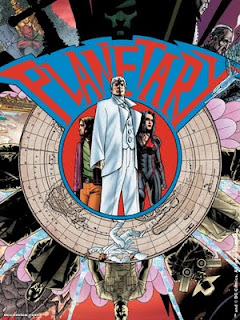
I first read Warren Ellis' Planetary in trade paperback format, more than a decade after its initial release. It is about a group of three people who call themselves the "Archaeologists of the impossible". They uncover the secrets of the pop culture and superhero genre and uncover the planet's secret history which is being horded by their rival four superhumans (who are based on the comics' Fantastic Four). The subjects range from the real story behind Japan's movie monsters (Gojira, Mothra) to an untold origin story of Lone Ranger and Tonto, to a what-if story of Superman, Green Lantern and Wonder Woman. There are stories which tells about a Galactus-like character and his demise; story about real technology behind Thor's hammer; the origin of Captain Marvel; a tale of John Constantine and Spider Jerusalem and many more fantastic ones.

The whole series basically suggests that all stories in the comic books and pop culture phenomena of the past century actually happened due in some part to the machinations of The Four. It is a very highly recommended read. If you haven't already, you should go to the bookstore now and get it. It's a must read. I can't reiterate it enough. But I don't really want to discuss or review this masterpiece work right here as it had been already reviewed with flying colors elsewhere on the net.


In the series we get a glimpse of the global Planetary organization. We learn that there are Planetary branches all over the world; Hongkong, Japan, Brazil etc. Definitely there are stories on these local places themselves that are worth a look even without the original 3 being involved. I'm thinking there should be some kind off spin-off adventure based on the original one. And I'm sure it would be great. Let Gabriel Ba and Fabio Moon handle the Brazil Planetario (a dream come true). Or Yoshitaka Amano (one can wish) draw the Japanese Planetary branch. These countries are rich in stories that can be starting point for amazing Planetary stories.

In particular, the Philippines has a lot of material that can be used for this kind of stuff. In fact there is one comic book that immediately comes to mind, Trese. Created by Budjette Tan and Kajo Baldisimo, Trese tells the story of a paranormal investigator aptly named Alexandra Trese who takes on cases with supernatural taste. They encounter aswang, nuno sa punso, tikbalang and many other creatures based from Philippine folklore.


But in some cases Trese and the gang also get to cross with "real" (as opposed to folk tale supernatural) beings. They meet Robinson, the rumored snake under a city mall's basement who allegedly eat customers that go inside one of the fitting rooms. There's a story about Darna, or whatever happened to her after all these years. They also tell the story behind the scenes of a rags-to-riches actress from those prolific 80's movie drama.

Going back to the original topic, Planetary's Philippine branch could be named Pandaigdig ("Daigdig" = Filipino word for planet, "Pan- or Pang-" = Filipino preposition to indicate purpose, i.e. for the planet.) The Pandaigdig crew (come to think of it, Alexandra Trese can become one of the three, she can be the Jakita Wagner of the group) would tackle the secret stories behind the stories.

There could be stories that serves as an analysis of the archetypical Bida-Kontrabida synergy on Filipino action films. There could be stories about the old slapstick comedy of Palito and how he was really a Filipino secret spy during the World War 2. There could be an issue that will encompass the golden age of Filipino komiks and would have cameos by Captain Barbell, Darna, Lastikman, Panday and others. There could be a retelling of the real story behind the Edsa 1, 2 and 3 and how it was really a machination of someone more sinister and supernatural in nature. It could involve Jose Rizal and Andres Bonifacio, our national heroes who turn out to be more than just heroes. An appearance by Manny "Pacman" Pacquiao (Is he called Pacman because he made a Pact with someone?)

End wishlist.

Anyway, I think Trese Book 4 is coming out soon (November I think) and I am eagerly anticipating it's release. It's another highly recommended book and everyone should read it. Also, Budjette Tan writes another comics title, Precinto 13 and it's another great read which focus on Captain Guerrero's side of the story, a la Gotham Central by Ed Brubaker and Greg Rucka. I hope it gets included in the next Trese book.

End story.

Thursday, May 26, 2011

A Short Discourse on the Trajectory of a Chalk Projectile (Or how I lost a battle and how I wished it would have turned out)

During my college years as a physics undergraduate, I attended a chemistry class wherein the professor takes pride in putting her field of study in the pedestal. She is one of those professors who will fight to death to defend that her chosen field- in her case, chemistry- is the most important field of knowledge.

In one of our introductory classes, we were discussing chemistry in general as the central science. She discussed how all the other fields simply support the claims of chemistry.

So she was going over her class list and asking every student to debunk the notion that chemistry is the central most important science. But when the student answers, she would simply create another argument to prove that chemistry is indeed the central science.

So she started asking everyone until she arrived at me. She called my name, 'Mister --,. I raised my hand and stood up. 'You're a physics student. So how can you prove that physics and not chemistry is the most important field of science?'

I was sure that she would just negate everything i would say so i did not even think of a very elaborate argument. I simply said in a very non-convincing tone, 'In Physics, we study how the world works.'
She paused for a while and looked around the class and grinned. I was simply waiting for the ultimatum. Then she spoke, 'So, how does the world work?'

I knew that was coming all along. But i'm not in any position to argue with her so i simply answered, 'We're still studying it'. And that's it--the class eroded with laughter and she just smirked as if saying 'I rest my case'.
---
Some years after that fateful day, i look back and realize how a loser I was, not being able to fight for what i believe. One time i wondered what would become of me had i fought back. In fact i made a scenario of what I wish happened then.
---
She was looking at her class list when she calls my name. 'Mister --,. I raised my hand and stood up. 

'You're a physics student. So how can you prove that physics and not chemistry is not the most important field of science?'

'In Physics, we study how the world works.'

'So, how does the world work?'

And then I would say, 'According to rules.' She would just look at me and say 'Go on'.

'Everything in our physical world works according to rules devised by nature. How the earth revolves around the sun is governed by the Laws of Planetary motion. How some chemicals react with each other is governed the law of thermodynamics. When a ball is thrown, it follows a trajectory governed by the law of motion and gravitation. We study those things in physics. So, everything can be explained by physics from a planet revolving to a ball thrown.'

She was simply staring at me thinking of a very good rebound, for everyone from the class knew that she was on a very low position right now. And then she got up.

She asked in a very attacking tone, 'Ok so how would you solve this problem, if I throw this chalk to your face, will it hit you or not?' At that point her ears are becoming red with rage and defeat.

So I answered her matter-of-factly, 'There are two scenarios to that problem,' I said, 'One, if you are very much annoyed by the fact that you have been defeated; that chemistry is actually not the most important science, then you will throw the chalk and try to hit my face. However, two, if you are reasonable enough to accept those facts, then you will put that chalk back to the table and debate with the class in a very civilized manner or you could throw it somewhere else. Either way, I will not get hit by that chalk because you will not be able to put into consideration the following factors; First, air resistance provided by the huge ceiling fan above me. Second, the mass of that chalk which is definitely very small since it has low density. Third, the low initial velocity provided by your weak arms. And fourth, my speed of evasion. Did that answer your question?'
---
Yeah, I know it’s kind of made up and very improbable but one can dream, right?

Friday, May 6, 2011

Data Limiting and Circumvention: A PostHuman Tale

A few years ago, there was a report published on an American publication which showed that on the average a person consumes about 34 gigabytes of information daily. This amount of information comes from various sources; TV, radio, books etc.

Based on this report, I began writing a story on what would happen if the government began limiting the data consumption of each person. What if there were implants embedded into the brains of every citizens so that when the limit is reached, the person will no longer be able to receive any more data?

In my story, this data censorship will lead to the evolution of human perception. To maximize and/or continue data reception, people will resort to various tactic. People may begin specializing in only a few senses and block all the others. People may try to filter unnecessary information input such as static, noise neglible pixels etc. People may train to just absorb fragments of the data but optimize their mind so that they can reform the fragment to its full form. Etc.

You can read the entire story here.

Excerpt:


With this new lifestyle, the citizens have minimized their dependence to information. Newspapers became adjunct and replaced with leaflets containing thoroughly condensed daily news. Television shows were revamped completely. They would now only include 1 to 2 minute shows in their programming. Likewise, the music industry was rebuilt from scratch and embraced the MIDI technology wholeheartedly as the main medium for the songs.

This is just the first part of a big story that I'm not sure would be finished.

Monday, May 2, 2011

Symbolic Urban Design

In the anime series, Full Metal Alchemist, in a world where alchemy is a commonplace (much like gasoline or electricity in our world) the Fuhrer King rules the city of Amestris. The king is in turn just a part of a shady group of people who is in control of the country. In the series, it was revealed that this group has planned to build the city from the very start into a form of a transmutation circle. A transmutation circle is a symbol, which when tapped correctly by a skillful alchemist, can give great powers to its designer. The King's group (the Homunculi) has an end game of turning the city into a transmutation circle which will transmute all its citizens into a powerful philosopher's stone, a relic capable of multiplying the powers of alchemy of the user.


I was intrigued by the concept of a whole city being built for one sole purpose, as an aesthetic or perhaps a functional symbol such as a Transmutation Circle. This concept has also been glossed over by Terry Pratchett and Neil Gaiman in their book Good Omens. In this book, they explained that the highway M25 in London is created in the image of the Dread Sigil Odegra. They also explained that this is the reason why motorists who pass into this highway seem to be possessed by evil and never reach the exit without experiencing carnage and frustration through out the route. According to the book, this feat is an acomplishment of the devil Crowley and that he considers this a "bad job well done".


In the US, conspiracy theorists have long believed that the country is being controlled by a group of individuals linked to Satanism or Freemasonry. They show as proof the Washington street layout which, according to them, forms a Luciferic symbol of an inverted star representing a goat's (devil's) head. This has become a center of many fictional works from authors like Brad Meltzer and Dan Brown.


It's interesting to know that it is possible for a whole bustling city or urban sprawl to be built just to serve one purpose; as a symbol, a sign, a building block, a unit which fits into a space of a larger puzzle.

A Grand Design as one might say. Every component, sub-unit or area of the city consciously or unconsciously is contributing to one purpose. In Amestris, the buildings form the symbol (the circle) while the citizen form the ingredients. In the M25, the highway itself forms the sigil while all the motorists become some sort of sacrifice to feed the dread sigil. While in the case of Washington, the streets form the symbol.

A common denominator for the designs is the existence of an overseeing entity to make sure the vision is complete, whether it is the Homunculi, the Devil himself or the Illuminati. I wonder if there are other real cities formed in similar circumstances?

Thursday, April 28, 2011

The Superheroes’ Moral Code


Written by J. Michael Straczynski and illustrated by Jesus Saiz, issue #28 of DC’s The Brave and The Bold entitled “Firing Line” features the team-up of the Flash with the Blackhawk. In the story, both were effectively removed from their ‘territory’; Blackhawk was grounded from flight while the Flash was slowed down by a leg injury.
One of the best moments in this Eisner-nominated story is when the Flash picks up a gun and wears an army uniform determined to fight for his country even if it means that he has to kill along the way.
This presents a case on how important it is to establish the real life character of a superhero in comics. A superhero is bounded by many rules just as there are rules of war. It’s just like how there are more strict instructions that guide soldiers because they are considered deadly weapons by themselves. It’s been said that a superhero’s great power also brings with it great responsibility (cf. Spiderman).
But remove the superhero’s costume and powers and you are left with a human being. And from there you have free rein to every human instinct and emotion that one is capable of. Hence, Clark Kent can make fun of Steve Lombardi’s hairpiece in return of Lombardi’s making fun of him (see All Star Superman). Peter Parker can NOT do his homework when he is feeling lazy. Bruce Wayne can get all the women he wants. These are things that Superman, Spiderman or Batman, in character, are morally prohibited from doing.


But sometimes, being in this non-superhero character without all these moral codes can do good. The Flash is the best example of this. In the panel above, The Flash is in a moral dilemma. He has to uphold his ethos: “The Flash doesn’t kill. The Flash doesn't carry a gun.” This he resolved simply by removing The Flash’s ethics from the equation and unleashing Barry Allen.
“…But Barry Allen, American, can do those things in the uniform of his country, which is at war.”
(As an antithesis to this proposition, one can say that it is the real life character’s principles that are holding the chains of the superhero alter-ego, preventing him/her from abusing his/her power. Best example is Grant Morrison’s Batman of Zurr-en-Arrh in the Batman RIP arc, which is the Batman without Bruce Wayne. But that is a topic for another post.)

Monday, April 25, 2011

War Heroes


“Filipino guerillas make do with any head covering.”
This caption is displayed on a head gear woven from the leaves of a coconut tree. The head gear, picture below, was used as a helmet during the World War II and is now displayed as part of an exhibit to commemorate Philippine Veterans Week.


The World War II Traveling Exhibit at Glorietta 5 in Ayala Center, Makati City ran from April 9 to 15 and showcased various photos, videos and memorabilia of the war such as the coconut head gear.
Talk about courage and innovation, the Filipino way.
Consider this scenario:
Manila, Philippines 1946-The Japanese battleship has docked. An attack is imminent. One can hear the humming of a multitude of tora-tora swarming the Manila skies like flies on a dead carabao.
From afar, a big explosion was heard. It has began. The Japanese soldiers started advancing. Armed with long, powerful guns, the Japanese army swept the land like locusts. No stone was left unturned. The tanks began to roll. Each lumbering piece of war machinery exuded control over those it surveyed.
The attackers unleashed every power they could muster. Bullets were loaded. Guns were cocked. Canons were charged. Missiles were engaged.
The planes continue to circle above like vultures. There was no escape – by land or by air. Manila is under siege.
I only know these through movies.
I can not fathom and I won’t pretend to understand the gravity of being alive during the World War II. How much more if you have to hold a gun and fight–something which you never thought you’d do in your lifetime. The Filipino veterans are admirable even just for the fact that even without proper training, they never hesitated to answer the call of the country.
The World War II Traveling Exhibit did not attempt to show the horrors and atrocities of the war. Instead, it showed the beauty and glamour that radiates from exceptional individuals during those times of tribulations.
On one side of the photo exhibit, a photo shows a nun smiling, while on the background only the smoking remains of a bombed building is seen. On another, a list of military units with corresponding numbers is posted – but the numbers do not indicate casualties but the number of individuals who heed the call of duty. Yet on another area, it displayed various tools that the Filipino soldiers used during hard-pressed times, clearly showcasing their adept ability to innovate.
What is perhaps most amazing is the memory board, a blank wall where everyone is free to write anything they want. It is amazing to know how proud and grateful people are to the veterans.
“I’m the wife of Cpl. This” says one of the comments signed with the commenters full name. “I’m proud to be the daughter of Cpl. That” says another also signed with a full name. “You are the real heroes” another commenter says. Throughout the exhibit’s one-week display, the memory board was filled with these kinds of salutations.
I never lived through a war, and I pray I never have to. But it wouldn’t take a war survivor to know that these soldiers should be honored for what they did. They are all heroes.

LinkWithin

Related Posts Plugin for WordPress, Blogger...